> ## Documentation Index
> Fetch the complete documentation index at: https://docs.scoutqa.ai/llms.txt
> Use this file to discover all available pages before exploring further.
# Files
> Upload test images and assets for Scout to use during explorations.
Files let you pre-upload images that Scout can use when testing file upload features in your application. Instead of skipping upload forms or using placeholder data, Scout can test your file handling with real images you provide.
## Why use files
Many applications include file upload functionality:
* Profile picture uploads
* Document attachment forms
* Image galleries and media libraries
* Receipt or invoice scanning features
By uploading test files to your project, Scout can exercise these upload flows and verify they work correctly—catching issues like format validation errors, size limit problems, or broken upload handlers.
## Supported file types
Scout currently supports image uploads:
| Format | MIME Type | Use Case |
| ------ | ------------ | --------------------------------------- |
| PNG | `image/png` | Screenshots, graphics with transparency |
| JPEG | `image/jpeg` | Photos, general images |
| WebP | `image/webp` | Modern compressed images |
| GIF | `image/gif` | Animated images, simple graphics |
Maximum file size is **5 MB** per image. Files larger than this will be rejected during upload.
## Uploading files
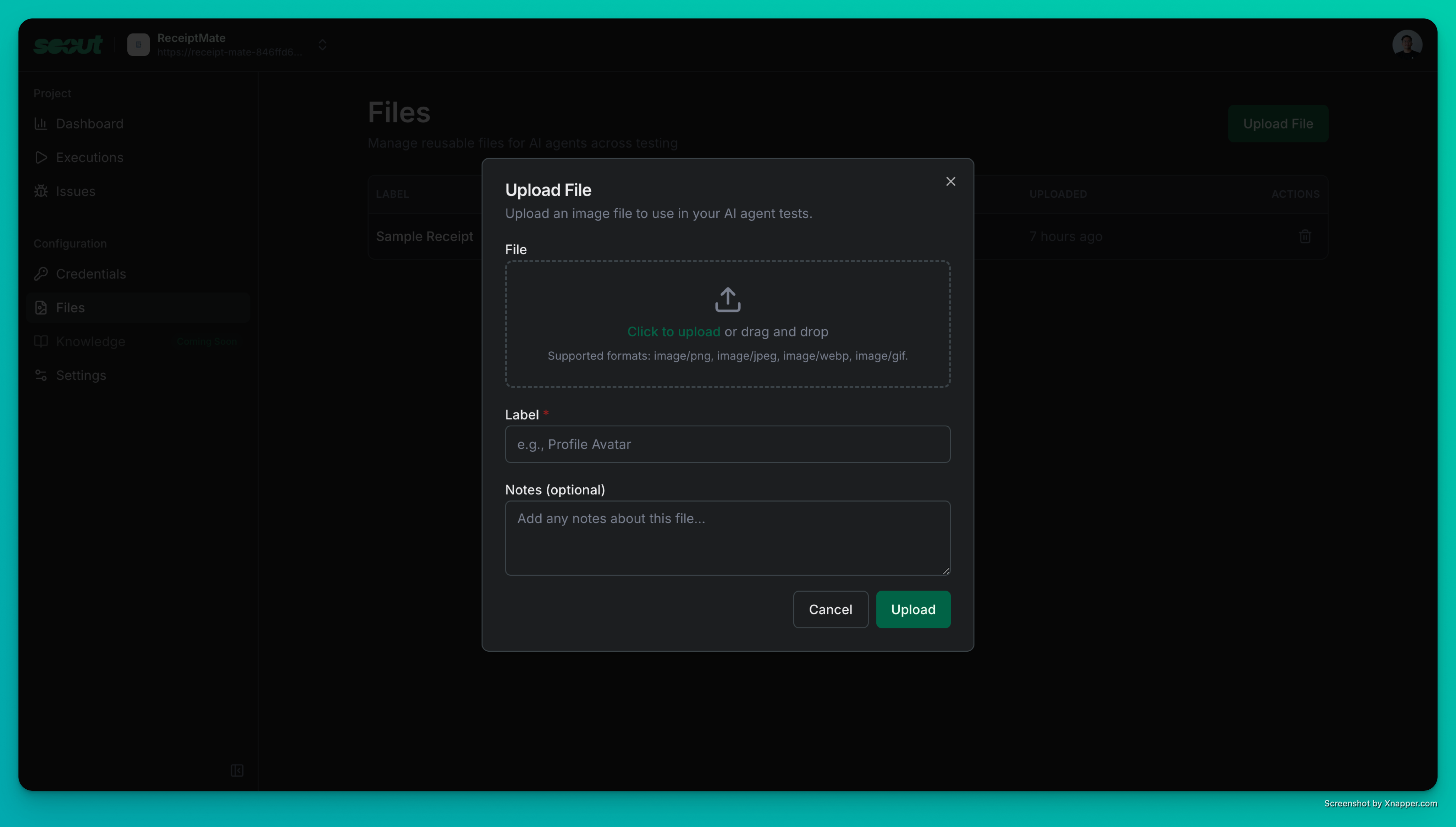 1. Navigate to your project settings
2. Select the **Files** tab
3. Click **Upload File**
4. Choose an image from your computer
5. Add a descriptive label (e.g., "Sample Receipt", "Test Profile Photo")
6. Optionally add notes about the file
7. Click **Upload**
## Best practices
Upload images that resemble what real users would submit. A sample receipt image tests your receipt scanner better than a random photo.
Include files that test boundaries: images near the size limit, different aspect ratios, various formats. This helps Scout find validation issues.
Use descriptive labels like "Large JPEG - 4.5MB" or "Portrait Photo - PNG" so you can easily identify files later.
Document what each file is meant to test. For example: "Use for profile photo uploads" or "Tests receipt OCR feature".
## How Scout uses files
During an exploration, when Scout encounters a file upload form:
1. Identifies the upload input and accepted file types
2. Selects an appropriate file from your project's uploaded files
3. Submits the upload and verifies the response
4. Reports any errors or unexpected behavior as issues
Scout intelligently matches files to upload contexts based on accepted MIME types and file requirements. Having a variety of file types and sizes gives Scout more options to test thoroughly.
## Managing files
1. Navigate to your project settings
2. Select the **Files** tab
3. Click **Upload File**
4. Choose an image from your computer
5. Add a descriptive label (e.g., "Sample Receipt", "Test Profile Photo")
6. Optionally add notes about the file
7. Click **Upload**
## Best practices
Upload images that resemble what real users would submit. A sample receipt image tests your receipt scanner better than a random photo.
Include files that test boundaries: images near the size limit, different aspect ratios, various formats. This helps Scout find validation issues.
Use descriptive labels like "Large JPEG - 4.5MB" or "Portrait Photo - PNG" so you can easily identify files later.
Document what each file is meant to test. For example: "Use for profile photo uploads" or "Tests receipt OCR feature".
## How Scout uses files
During an exploration, when Scout encounters a file upload form:
1. Identifies the upload input and accepted file types
2. Selects an appropriate file from your project's uploaded files
3. Submits the upload and verifies the response
4. Reports any errors or unexpected behavior as issues
Scout intelligently matches files to upload contexts based on accepted MIME types and file requirements. Having a variety of file types and sizes gives Scout more options to test thoroughly.
## Managing files
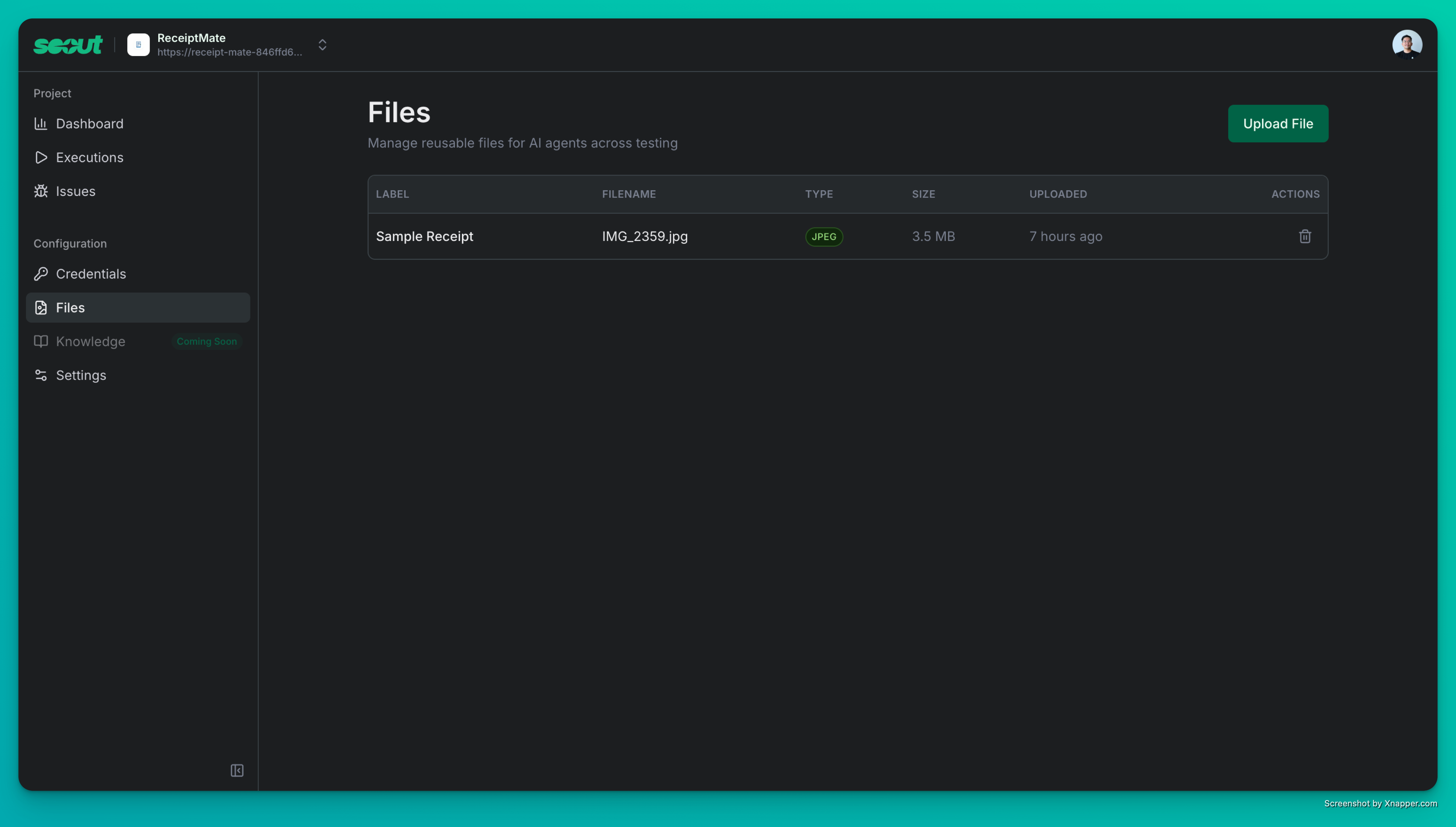 From the files list, you can:
* View all uploaded files with their labels, types, and sizes
* See when each file was uploaded
* **Delete** files you no longer need
Deleted files are removed from future explorations but won't affect historical execution records.
## File storage
Uploaded files are stored securely and associated with your project. They persist across explorations and can be reused as many times as needed.
Files are project-specific. Each project maintains its own file library, so you can tailor test assets to each application you're testing.
From the files list, you can:
* View all uploaded files with their labels, types, and sizes
* See when each file was uploaded
* **Delete** files you no longer need
Deleted files are removed from future explorations but won't affect historical execution records.
## File storage
Uploaded files are stored securely and associated with your project. They persist across explorations and can be reused as many times as needed.
Files are project-specific. Each project maintains its own file library, so you can tailor test assets to each application you're testing.